Greenville, SC and the Upstate · Mon - Sat, 8:00 AM - 6:00 PM
Soft Washing vs. Pressure Washing: What’s the Difference (and Which Do You Need)?
September 18, 2026
“Pressure washing” gets used as a catch-all term for exterior cleaning, but soft washing and pressure washing are genuinely different processes, built for different surfaces, and using the wrong one is one of the most common ways a cleaning job goes wrong.
The actual difference: PSI and chemistry
Pressure washing relies on mechanical force, water alone, driven at high pressure, to physically blast dirt, grime, and buildup off a surface. Residential pressure washing typically runs somewhere in the 1,300 to 2,800 PSI range, and commercial equipment can push past 4,000 PSI.
Soft washing relies on chemistry instead of force. A cleaning solution, typically a diluted sodium hypochlorite mix paired with a surfactant so it clings to vertical and sloped surfaces long enough to work, does the actual cleaning, and the rinse afterward runs at low pressure, generally under 500 PSI at the nozzle. The dirt and organic growth are broken down chemically, not blasted off.
Neither method is “better” in the abstract. They’re suited to different surfaces, and a lot of exterior cleaning damage comes from using the high-pressure method somewhere it doesn’t belong.
Why high pressure damages certain surfaces
This is the part most articles skip, and it’s the part that actually matters if you’re trying to decide which method your project needs.
- Asphalt shingles: the granules that protect a shingle from UV and weather are held on by asphalt, not permanently bonded. High pressure strips them off, which is why roofing manufacturers explicitly warn against power washing shingles.
- Vinyl siding: vinyl is engineered as a rain screen, overlapping panels with drainage gaps behind them, designed to shed water downward and outward. Most manufacturers cap safe pressure around 1,000 to 1,500 PSI. Above that, an upward or angled spray can force water behind the panels and into the wall cavity, where it doesn’t dry out on its own.
- Wood: wood absorbs water. High pressure applied directly raises the grain, can cause splintering, and accelerates the kind of moisture damage that leads to rot.
- Stucco and EIFS: these are porous, cementitious systems that aren’t rated for high pressure. Forced water can penetrate behind the assembly, trapping moisture inside the wall where mold and rot can develop unseen.
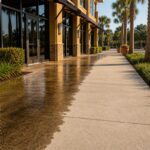
Concrete, pavers, and most masonry are the other end of the spectrum: dense, non-absorbent surfaces that generally handle higher pressure well, which is why driveways and patios are usually pressure washed rather than soft washed.
Does soft washing kill plants?
This is a fair question given that soft washing uses a bleach-family chemical, and the honest answer is: it can, if it’s done carelessly, but it doesn’t have to. The actual harm mechanism isn’t the water. It’s chemical scorch on leaf tissue from concentrated solution contact, plus nutrient disruption in soil from heavy runoff.
The real plant-safety practices that prevent this:
- Pre-soaking plants and soil with plain water before any chemical contact. Hydrated plant tissue absorbs less of the cleaning solution
- Covering sensitive beds directly under the work area rather than assuming overspray won’t reach them
- Using the lowest effective concentration for the surface, paired with a plant-safe, biodegradable surfactant
- Rinsing foliage and runoff thoroughly immediately after the solution has had time to work
Done this way, soft washing around established landscaping is routine, not risky. The problems happen when a solution is left to dwell too long, applied too concentrated for the job, or the runoff isn’t rinsed away.
Which one does your project need?
| Surface | Method |
| Roof (asphalt, most residential) | Soft wash only |
| Vinyl, wood, stucco, fiber cement siding | Soft wash (default) |
| Concrete driveways & sidewalks | Pressure wash |
| Pavers | Pressure wash, lower PSI/wider fan |
| Wood decks | Low-pressure/wood-safe, closer to soft wash |
In practice, most full-property cleanings use both methods: soft washing on the roof and siding, controlled pressure washing on the concrete and hardscape. See our house washing and roof soft washing pages for how we handle each.
Yes, and it's actually the safer default for most siding, especially older vinyl, which can crack or warp under direct high pressure. We use soft washing on siding unless a surface specifically calls for higher pressure.
It can if done carelessly, but the real risk is chemical scorch from concentrated solution contact, not the water itself. Pre-rinsing plants, covering sensitive beds, and rinsing runoff thoroughly afterward prevents this. It's standard practice, not an extra step.
Because it damages surfaces that aren't built for it. Stripped roof granules, water forced behind vinyl siding, splintered wood, and water intrusion behind stucco are all real, well-documented risks of using the wrong method.
Get a Free Quote
Serving Greenville, SC and the Upstate. Call (864) 477-1558 or request a quote online. We respond within 2 business hours.