Deck Cleaning vs Staining: What to Do First and How Long to Wait
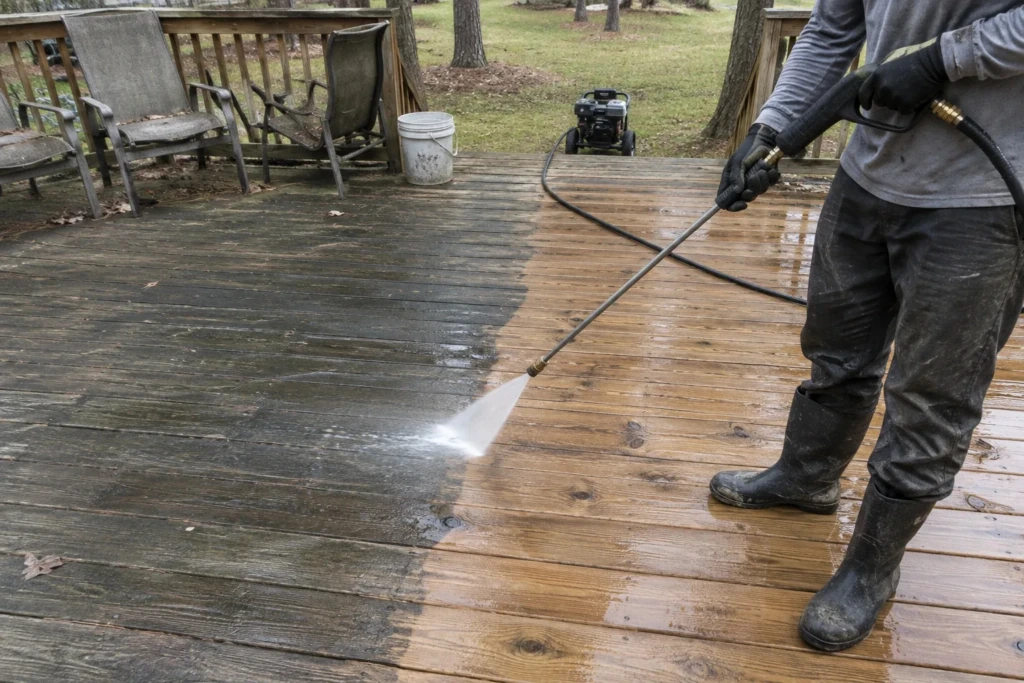
Quick answer: always clean first, then stain. Stain only bonds to clean, dry, open wood, so a deck that is washed and brightened, then left to dry 48 to 72 hours, will hold its finish far longer than one stained over gray fibers, mildew and old coating. After pressure washing, wait at least 48 hours in dry weather, confirm with a moisture meter reading under about 15 percent (many oil based stain makers want 12 percent or less), and sprinkle water on the boards. If it soaks in within a few seconds, you are ready to stain.
Below: why the order matters, which cleaner to use, safe pressure, how to tell when wood is really dry in Upstate humidity, which stain to choose, what to do with composite, and typical costs around Greenville.
Why cleaning always comes before staining
Stain is not paint. Penetrating stains soak into the wood fibers, and even solid stains need a sound surface to grip. Every deck stain maker we checked says the same thing in its own words. Olympic calls cleaning “the most important step to staining” because “a clean surface allows the stain to soak in and properly cure.” Ready Seal says the surface “must be clean of mildew, dust, dirt, oil and grease” before you apply. Thompson’s WaterSeal adds a point many homeowners miss: a pressure washer alone “leaves behind mold, mildew, and algae spores,” which is why a cleaner step matters even when the deck looks clean after rinsing.
Skip the wash and the stain bonds to dead gray fibers, pollen and mildew instead of the wood. The first wet season pushes moisture up through the boards, that loose layer lets go, and the stain peels with it. Blotchy color is the other common result.
The order is simple: clean, brighten, dry, test, then stain. If you are in Greenville and want the cleaning step handled, our deck and patio cleaning service preps wood with a cleaner, low pressure and a brightener so the surface is ready for whatever finish you choose.
Cleaner vs brightener: what each one does
Most deck prep uses two products in sequence, and they are not interchangeable.
Step 1: the cleaner
The cleaner removes dirt, mildew, algae and the gray surface fibers. Common types are sodium percarbonate (oxygen bleach), sodium hypochlorite (chlorine bleach) based mixes, and sodium hydroxide, which is really a stripper. Pros on pressure washing forums favor percarbonate for routine cleaning because it is gentler, and warn that strong hypochlorite or caustic mixes left on too long cause “furring,” the fuzzy white fibers that appear after the wood dries.
Step 2: the brightener (oxalic acid)
Most cleaners are alkaline. They raise the pH of the wood and can leave it darker or dull, and on cedar and redwood they pull tannins to the surface as brown or black streaks. A brightener is an acid, usually oxalic acid, that neutralizes the cleaner, dissolves tannin and iron stains, and opens the grain so stain absorbs evenly. Cabot says its brightener “removes rust stains, tannin bleed and dead, gray wood fibers.” Spray it on after the cleaning rinse, dwell about 10 minutes, rinse lightly.
Skip the brightener and the color often comes out muddier than the sample chip. It also clears the black dots around nail and screw heads on pressure treated pine, the wood on most Upstate decks.
How much pressure is safe on a wood deck?
Less than you think. The cleaner does the work; the washer is a rinse. Stay around 500 to 1,200 PSI on wood with a wide fan tip, a foot or more off the boards, moving with the grain in long overlapping passes. Thompson’s suggests 1,200 to 1,500 PSI; Ready Seal caps it at 1,500 and says to start with the widest tip 18 inches away. Pros often stay near 800 to 1,000 PSI on pine and lower on cedar, which furs more easily.
Signs of too much pressure: raised grain that feels like fur, wand stripes, splintered edges. Rotten boards need replacing, not washing. For a deeper look at why low pressure and the right chemistry beat raw force on almost every exterior surface, read our guide to soft washing versus pressure washing.
- Use a 25 or 40 degree fan tip, never a zero degree pinpoint tip.
- Start at 500 PSI and only increase if the cleaner has not lifted the gray.
- Work with the grain, board by board, overlapping each pass.
- Keep the wand moving and rinse railings, balusters and steps too.
- Pre-wet plants and beds before you start and rinse them after.
How long after pressure washing can you stain a deck?
Why the spread? Water based stains tolerate a bit more moisture than oil based. Ready Seal is blunt: “oil and water do not mix,” and dryness “can NOT be definitively determined just by touching the wood or by simply allowing a certain number of hours.”
Greenville drying times run longer than the label
Greenville gets about 43.7 inches of rain a year, spread fairly evenly across every month, and the muggy season runs from late May to late September with July the worst at roughly 23 muggy days. A deck that would dry in 48 hours in a dry climate can easily need 3 or 4 days here in July, and a deck in deep shade may need longer than that.
Practical scheduling: look for 3 or more dry days in the forecast after the wash, and prefer spring (after the pine pollen drop) or early fall over midsummer. Most stains want air and surface temperatures above about 50 degrees during application and for a day or two after.
Two tests that tell you the wood is really dry
The moisture meter
A pin type meter costs $20 to $40. Test several boards, including shaded spots, board ends and the lowest step:
- Under 12 percent: ready for any stain, including oil based. Ready Seal requires 12 percent or less.
- 12 to 15 percent: fine for most water based stains; many pros use 14 to 15 percent as their cutoff.
- Over 15 percent: wait another day and re-test. Stain applied now is likely to blotch or peel.
Meter at midday after the dew burns off, not first thing in the morning.
The water bead test
No meter? Sprinkle a few drops of water on several boards. Thompson’s describes it this way: if the water “absorbs and darkens the color of the substrate within five seconds, the surface is porous and ready to be treated.” If it beads up or sits on top, the wood is either still wet, still sealed by old finish, or has mill glaze from the lumber yard. The first case needs more drying time. The second needs stripping. The third needs a light sanding with 60 to 80 grit.
Strip or clean? How to decide
Cleaning removes dirt, mildew and gray fibers. Stripping removes an old finish. If your deck has never been stained, or the old penetrating stain has worn away evenly, a clean and brighten is enough. If there is an old film forming finish (most solid stains, old sealers, anything shiny), you need a stripper before the cleaner, and often a sanding pass after. Cabot’s stripper, for example, is made to remove “both water and oil based finishes” and “all traces of dirt and peeling finish.”
Quick decision guide:
- Water soaks in everywhere after cleaning: no stripping needed.
- Water beads in patches: old finish is still there in those spots. Strip those areas or the whole deck.
- Old solid stain is peeling: strip and sand, or switch to a solid stain that can go over a sound, scuffed surface.
- Changing from solid to semi-transparent: strip everything. Semi-transparent cannot hide old pigment.
Strippers are caustic. Wear gloves and eye protection, keep them off siding and plants, and always follow with a brightener. Stripping is where DIY projects go sideways on time, which is why pro prices jump when it is involved.
Which deck stain should you use?
Choose opacity first, then base.
- Transparent or clear: shows full grain, little pigment, least UV protection, usually recoated every year or so in sun. Best for new cedar.
- Semi-transparent: color with visible grain, typically 2 to 3 years, the most popular pick for pressure treated pine. Least forgiving of poor prep and damp wood.
- Solid: hides the grain like paint, most UV protection, often 4 to 5 years, best for older or patched decks. Forms a film and fails by peeling, so the next recoat means more scraping.
Oil based vs water based
- Oil based: penetrates deeper, richer color, wears away gradually instead of peeling, easier to recoat without stripping. Needs very dry wood (12 percent or less), longer dry time, stronger fumes, and can feed mildew in shade if it lacks a mildewcide.
- Water based: faster drying, low odor, easy soap and water cleanup, more color stability, resists mildew better. Can peel if applied over dirty or glazed wood, and some lines can look plasticky.
Whichever you pick, read the can. Wait times, temperature windows and recoat rules vary by product and override any general number in this article.
New treated lumber: do not stain it the week it is built. Thompson’s says to wait 30 days on new pressure treated wood; Ready Seal wants at least 1 month and prefers 2 to 3. Test it like old wood and give it a light clean and brighten first to remove mill glaze.
Composite decks: clean, do not stain
If your deck is Trex, TimberTech, Azek or a similar composite, the question answers itself. Composite boards are designed to be cleaned, not finished. Trex’s care guide says its Transcend, Enhance and Select boards may be washed with “a pressure washer with no greater than 3100 psi that has a fan attachment/adjustment and soap dispenser,” using “a fan tip no closer than 8 in.” from the surface, and that exceeding that pressure “will void the warranty with respect to any condition caused by the pressure washing.” Trex also warns that “products containing bleach or acid will lighten the surface,” so wood cleaners and brighteners are not for composite.
Why no stain? Capped composite has a plastic shell that stain cannot penetrate, so a coating sits on top and peels, and coating is generally a warranty problem. The right routine is warm soapy water and a soft brush, a composite safe cleaner for mildew, and low pressure rinsing. We clean composite under the manufacturer limits as part of our deck cleaning in the Wade Hampton area and across Greenville County.
Why mildew keeps coming back on shaded Upstate decks
Greenville is a Tree City USA with roughly a third of the city under tree canopy, and homes near Paris Mountain State Park sit under mature hardwood and pine. That shade keeps a deck damp long after rain and drops leaves, pollen and sap that feed mildew. Add the long muggy season and mildew has everything it needs.
Cleaning kills what is there; it does not change the conditions. To slow the return:
- Sweep leaves and pine straw off the deck weekly in fall and spring. Debris sitting on wood holds water for days.
- Clear the gaps between boards so rain can drain through instead of pooling.
- Trim low branches to let in more sun and air.
- Use a stain with a mildewcide, and consider water based in deep shade; oil based finishes without mildewcide can feed growth.
- Plan a light maintenance wash every year or two rather than a heavy restoration every five; our guide to how often to pressure wash your house covers the same logic for siding.
Spring pine pollen is the other local wrinkle: stain during the drop and it ends up in your finish, so wash after it is done. If the same green film is on your roof, see our roof moss and algae guide. Homeowners in heavily wooded parts of Taylors and Travelers Rest tend to see faster mildew return than those on open lots closer to downtown, so build that into your recoat schedule.
What it costs around Greenville
Every job is quoted on its own, but these typical ranges will help you budget. Our pressure washing cost guide has the full local breakdown for other surfaces.
- Professional deck cleaning and brightening: about $0.30 to $0.80 per square foot, typically $150 to $500 for a wood deck depending on size, railings and condition.
- Staining by a painter or deck contractor: nationally about $2 to $5 per square foot including light sanding; $4 to $7 per square foot when the old finish has to be stripped first.
- Stripping alone: about $1 to $3 per square foot. Sanding: about $1 to $4 per square foot.
- DIY materials: cleaner and brightener $30 to $60, stain $25 to $90 per gallon, one gallon covering roughly 150 to 300 square feet per coat. A moisture meter is $20 to $40.
Railings and balusters are the hidden cost; a 300 square foot floor can carry as much surface area again in spindles.
DIY or hire it out?
Cleaning a deck yourself is realistic if the deck is small, at ground level, uncoated or lightly coated, and you own or rent a washer you can throttle down. Hire out the cleaning if any of these apply:
- The deck has an old solid stain or sealer that needs stripping.
- It is a second story deck or wraps around slopes where ladder work is involved.
- The wood is cedar, redwood or another soft species that furs easily.
- You want the deck cleaned, dried and staged so a painter can stain on a set date.
A good split for many homeowners is to hire the cleaning and brightening, then stain it yourself once the meter reads dry. Cleaning is where equipment and chemistry mistakes do permanent damage; staining is mostly patience and a good brush. If you hand off both, schedule the two visits with a dry gap between them. We handle deck prep across the county, including Simpsonville and Greer, and will tell you honestly when a deck needs a carpenter before it needs a wash.
Questions to ask before you book
- What PSI and tip do you use on wood, and do you use a cleaner and a brightener?
- Will you tell me if boards are rotten or the deck is not worth restoring?
- When will it be dry enough to stain, and will you check with a meter or at least do the bead test?
Mistakes that ruin a deck stain job
- Staining the same day as washing. The surface feels dry; the wood is not.
- Skipping the brightener. Alkaline residue dulls color and can shorten the stain’s life.
- Using a zero degree tip or standing too close. This is where furring and stripes come from.
- Staining in direct July sun. The stain flashes off before it penetrates and leaves lap marks.
- Applying too much stain. Penetrating stains should soak in; puddles that do not absorb in 15 to 20 minutes will stay tacky and peel. Back-brush them out.
- Trusting the 48 hour number during a humid stretch instead of testing.
- Putting any stain or bleach based cleaner on a capped composite deck.
Ready to get the first step done right? Request a free quote or call (864) 477-1558 and we will clean and brighten your deck so it is ready for stain, and tell you plainly how long it should dry in this week’s weather.
Sources
- readyseal.com: /resources/faqs
- thompsonswaterseal.com: /en/how-to/faqs
- trex.com: /care
- cabotstain.com: /en/products/surface-prep
- olympic.com: /how-to/how-to-stain-a-deck
- behr.com: /how-to/stains/how-to-stain-a-deck
- homelight.com: /blog/how-to-clean-a-deck-before-staining
- fixr.com: /costs/stain-deck
Usually not in Greenville. Wash on day one, then you need at least 48 hours of dry weather, and often 72 in summer humidity, before the wood is ready. A Saturday wash and a Tuesday or Wednesday stain is realistic. A Saturday wash and Sunday stain almost always leads to blotching or early peeling because the wood below the surface is still wet.
Yes. Clear furniture, grills, planters, rugs and anything stored underneath if the deck is elevated, and close windows and doors. Cover or move anything you cannot lift. Plan to keep it all off the deck through the drying period, since a rug or planter sitting on wet wood leaves a dark, slow drying patch that will show through the stain.
It can if it is left to dry on leaves. Ask the company to pre-wet plants and beds, rinse them during and after the job, and keep runoff out of storm drains. Percarbonate cleaners are gentler than chlorine mixes, and brighteners are rinsed off quickly. If you clean the deck yourself, soak plants first and rinse them again when you are done.
Sprinkle water on it after a thorough clean. If it soaks in everywhere, the old finish is gone and you only need cleaning and brightening. If it beads in patches, a film is still there and those areas need a stripper, then a brightener, before stain. Any peeling solid stain or shiny sealer needs stripping and sanding regardless.
Under 15 percent for most water based stains and 12 percent or less for oil based penetrating stains such as Ready Seal. Take readings at midday in several spots, including shaded boards and step treads, and use the highest number, not the average. If any board reads high, wait another dry day and test again.
No. Composite is washed with soapy water, a soft brush and low pressure, not deck cleaner and brightener. Trex allows pressure washers up to 3,100 PSI with a fan tip held at least 8 inches away, and says bleach or acid products can lighten the boards. Composite is not stained, so the only job is a careful clean and a mildew check in shady spots.
Get a Free Quote
Serving Greenville, SC and the Upstate. Call (864) 477-1558 or request a quote online. We reply quickly to every request.