How to Remove Oil Stains from Your Driveway (and When to Call a Pro)
Quick answer: Match the method to the age of the stain. Fresh oil needs an absorbent (non-clumping cat litter, cornstarch or baking soda) within hours. A stain that has set for days or weeks needs a concrete degreaser, real dwell time, a stiff brush and hot water. Old, dark stains need a poultice that pulls the oil back out of the pores, often two or three rounds. Pressure washing comes last, never first, because water pressure on untreated oil spreads it.
Concrete is porous, so oil does not sit on top like dirt. It wicks into the pores and bonds there, which is why a drip that looked harmless in spring can be stubborn by the time Upstate summer heat and humidity settle in. This guide covers fresh vs old stains, sealed vs unsealed concrete, asphalt, the myths that waste your weekend, what to do with the waste, real Greenville costs and when to stop and call a pro.
Which method fits your stain? A quick decision guide
- Fresh (minutes to 24 hours): blot, then absorb. Most never become permanent stains.
- Set-in (days to a few months): degreaser, 15 to 30 minutes of dwell time, hard brushing, hot rinse. Repeat once if a shadow remains.
- Old (a year or more, dark, deep): poultice, usually two or three rounds, then a degreasing wash.
- Not dark brown or black? It may be rust, clay or tannin, not oil. Run the test below before buying anything.
- Asphalt, pavers or sealed concrete? Different rules apply. Read those sections first.
- Big area, years of drips, or you cannot catch the wash water? Skip to the pro section.
Safety first: what to wear and what to keep away from the stain
Degreasers are alkaline or solvent based, and some poultice solvents are flammable. Wear chemical-resistant gloves, safety glasses and closed shoes. Work outdoors in the open air, keep cigarettes, pilot lights and sparks well away, and never mix products (especially bleach with anything containing ammonia or acid). Keep kids and pets off the slab until it is rinsed and dry, and read the label for your specific product.
How do you remove a fresh oil spill from a driveway?
Blot first with paper towels or an old rag. Press, do not wipe, so you do not smear it. Then cover the spill and an inch or two past its edges with a thick layer of absorbent: non-clumping clay cat litter, cornstarch, sawdust or baking soda. Grind it in with the sole of an old shoe, leave it for several hours or overnight, then sweep it up and bag it. Repeat if the powder comes up dark and wet.
Finish with a degreaser or dish soap and warm water, 10 to 15 minutes of dwell, a brush and a controlled rinse (see the wash water section). Do not hose the spill first. Water carries oil outward and downhill, and it makes the spill harder to absorb.
Does time matter? Fresh vs old stains
Yes, more than the product does. In the first hours oil is mostly sitting in the top layer of the slab and an absorbent can take most of it. Within days it migrates deeper and bonds, and over months it oxidizes and darkens. That is why a stain that is a year old may need a poultice that a same-day spill never would.
Heat matters too. Oil spreads faster into warm concrete, so a Greenville driveway in July can take up a spill quickly. If you cannot clean up right away, cover the spot with absorbent and leave it. A thick layer of litter buys you time.
How do you get dried oil off a driveway?
Dried oil has already worked into the pores, so absorbents alone will not do much. Use a degreaser formulated for concrete (alkaline or citrus based, read the label), and follow the steps in order:
- Sweep the area, then wet the surrounding concrete lightly so cleaner does not travel past the stain.
- Apply degreaser to the dry stain and keep it wet for the label’s dwell time, usually 15 to 30 minutes. Mist it if it starts drying.
- Agitate with a stiff nylon brush or drill brush, working in circles for several minutes.
- Rinse with hot water if you can. Heat helps release oil, but it does not pull deep oil out on its own.
- Let the concrete dry fully before judging the result. Damp concrete always looks darker. If a shadow remains, repeat once, then move to a poultice.
Does Dawn dish soap remove oil stains from concrete?
For a fresh or light stain, yes. Dish soap is built to cut grease, so squirt it on, add a little hot water, scrub with a brush for several minutes and let it sit 15 to 30 minutes before rinsing. It does not harm bare concrete, though strong detergents can cloud some sealers, so test a corner first.
The limit is depth. Soap works at the surface and will not reach oil that has bonded below it. On anything old, expect it to lighten the stain, not remove it. Leaving it on longer does not fix that; it just dries.
How do you remove an old oil stain from concrete?
You have to pull the oil back out, and that is what a poultice does. A poultice is an absorbent powder mixed with a solvent into a paste. The solvent dissolves the oil deep in the pores, and as the paste dries it wicks the dissolved oil up into the powder.
Option 1, the easy one: a ready-made pour-and-dry product (commercial oil and grease stain removers sold for concrete). You pour it on, let it dry to a crusty powder over roughly 5 to 12 hours, then scrape and sweep it off. Follow the label for coverage and repeat for stubborn stains.
Option 2, the DIY paste:
- Absorbent: diatomaceous earth, bentonite clay or plain clay cat litter ground fine.
- Solvent: a concrete degreaser or a product sold as a poultice solvent is the safest choice. Some guides use acetone. Acetone is highly flammable, its fumes are strong, and the soaked clay is solvent waste, so work outdoors, away from any flame or spark, with gloves and eye protection, and treat the leftovers as hazardous waste (see below).
- Mix and spread: peanut-butter consistency, about 1/4 inch thick, a little past the stain edge.
- Cover: tape plastic sheeting over it to slow evaporation. Leave it 12 to 48 hours, then remove the plastic and let it dry completely.
- Scrape, sweep, repeat: a very old stain often needs two or three rounds. Finish with a degreasing wash.
Be realistic about the result. A drip pattern under a leaking engine that has sat for years may come out 80 to 90 percent and leave a faint ghost. That is a normal outcome, not a failure, and it is far better than dark and spreading.
Does hot water help? What about enzyme cleaners?
Hot water helps because heat thins oil and makes degreaser work faster. It is the reason heated “power washing” beats cold water on grease. But hot water alone, without a degreaser, mostly moves oil around. Think of it as an accelerator, not the cleaner.
Enzyme and microbial cleaners use bacteria that digest hydrocarbons slowly, over days or weeks. They suit large, low-urgency areas in warm weather, such as a shop floor or a long-neglected driveway where you are not in a hurry. They are not a quick fix for a deep, dark spot, and results vary by product, so follow the label and give them time.
What is the best cleaner for oil stains on a driveway?
There is no single best product, only the best match for the stain. Fresh: cat litter or cornstarch. Moderate: a concrete degreaser. Old: a pour-and-dry poultice or a solvent-and-clay poultice. Large areas or years of staining: a professional with hot water and a surface cleaner. Whatever you pick, test it in a small hidden spot first and let that spot dry before you commit.
What does NOT work, and what is risky?
A lot of online advice is weak and some of it is genuinely unsafe. Here is what to skip:
- Gasoline or kerosene: never. It is a fire and vapor hazard, it is itself a petroleum contaminant, and it adds more oil to the pores.
- Brake or carburetor cleaner: some DIY write-ups spray whole cans onto a driveway and cover it with cat litter, with no mention of flammability, fumes, gloves or runoff. These products are not made for this, and the waste ends up in the ground or the storm drain.
- Acetone with no safety steps: it can work in a poultice, but a guide that skips ventilation, ignition and disposal warnings is leaving out the parts that hurt people.
- Bleach: bleach does not dissolve oil. It can discolor concrete, and it is not the answer for rust either.
- Muriatic acid: it etches concrete and does not remove oil. You get a rough, blotchy patch that is more visible than the stain, plus hazardous runoff.
- Pressure washing alone: plain water pressure drives oil deeper at the center and smears it wider at the edges. Degreaser first, pressure last.
- Wire brushes, grinding stones and oven cleaner: they scar or burn the surface, which then holds the next stain even better.
Does WD-40 remove oil stains from concrete?
Not really. WD-40 is itself a petroleum-based lubricant, so spraying it on oil swaps one oily film for another that attracts dirt. You still have to degrease the area afterwards, which is more work than going straight to a degreaser.
Does Coca-Cola remove oil stains from concrete?
It may lighten a very fresh stain a little because of its mild acidity, but cola is not a degreaser and leaves sticky sugar behind that feeds algae and attracts dirt. It is a popular hack, not a solution. Skip it.
Will CLR remove oil from concrete?
CLR is designed for calcium, lime and rust deposits, not oil. On an oil stain it mostly wastes product and can etch the surface. Save it for mineral stains, and read the label first.
Sealed vs unsealed concrete: does it change the method?
Yes, a lot. On a sealed driveway the sealer holds oil near the surface, so prompt cleanup often lifts nearly all of it. Use gentler cleaners and skip aggressive solvents, which can soften or cloud some sealers. On unsealed, broom-finished concrete, common on Upstate driveways, oil moves in fast and a poultice is more likely.
A quick check: sprinkle a few drops of water on the slab. If they bead, there is probably a sealer. If they darken and soak in within a minute or so, it is bare. Either way, test any product in an inconspicuous corner first. If a stain survives on sealed concrete, the sealer may be worn through at that spot.
What about oil on an asphalt driveway?
Asphalt is different, and it is where DIY mistakes cost the most. Asphalt is itself petroleum based, so solvents and oil soften the binder, leaving a pitted, sticky patch. Skip solvent poultices and hard scrubbing. For a fresh spill, absorb it, then use a mild degreaser labeled safe for asphalt, and rinse gently with low pressure.
A sealcoat protects against occasional drips, though a heavy leak will still mark it. Fresh black sealcoat can also hide stains, which is not the same as removing them. If the surface is already soft, flaking or raveling, call a paving or cleaning professional before you make it worse.
Is it oil or is it rust, clay or something else?
Orange, brown and reddish stains are not always oil. Red clay, iron-rich irrigation water and rusty metal can all stain concrete (see our guide on why red clay stains concrete faster). A simple check:
- Oil: dark brown to black, often with a greasy sheen when fresh. Water beads or spreads slowly on it.
- Rust: orange or red-brown, often in a spray or ring pattern under a sprinkler head or beneath metal. Water soaks in like it does on the rest of the slab.
- Clay and tannin: a broad tan-to-red film, often at downspouts and after rain, that lightens with a good wash.
Rust needs an oxalic or phosphoric acid based rust remover, never bleach and never a degreaser. Mix up the two and you waste a weekend.
Are oil stains on a driveway permanent?
Rarely permanent, but they get harder every month. A fresh spill usually comes out completely. An old one often lightens a lot and may leave a faint shadow because the oil has bonded deep. The most reliable way to stop a stain becoming permanent is to treat it within hours, and to seal the concrete once it is clean.
Why pressure washing alone fails on oil, and when it helps
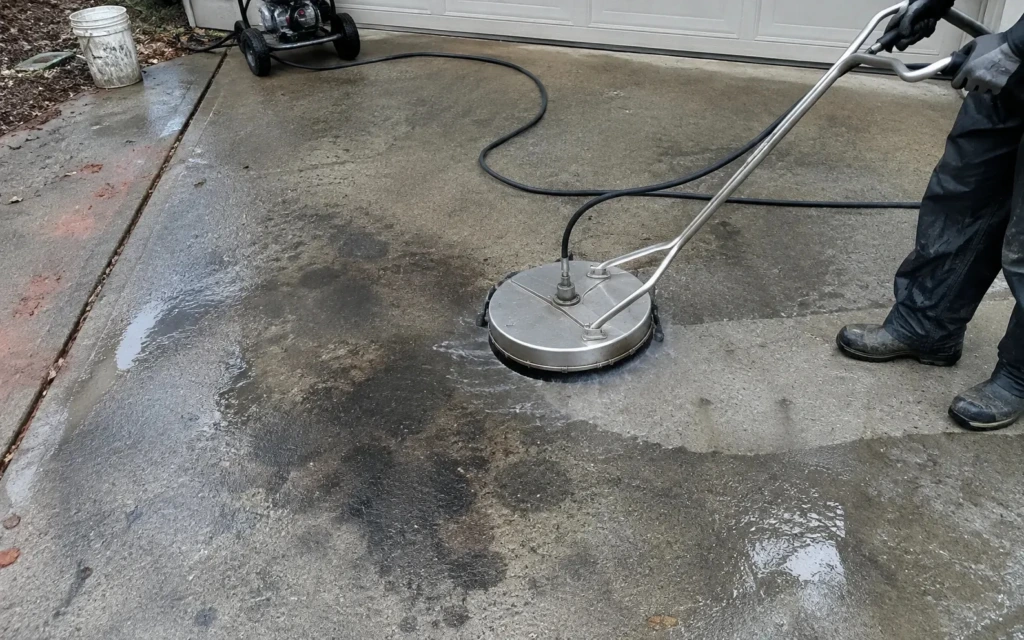
A pressure washer moves water, not solvent. On oil it pushes the film deeper at the center and out to the edges, and it can leave a pale, cleaner-looking halo around a dark core. Where it does help is after the stain has been treated: once a degreaser has loosened the oil, hot water and a surface cleaner rinse it away evenly. Our driveway cleaning service works in that order for exactly this reason.
Where does the wash water and cleaning waste go?
This matters more than most people think. Greenville County’s stormwater program lists dumping motor oil or other household hazardous waste into a catch basin, and letting wash water enter a storm drain, as examples of illicit discharge. Storm drains do not lead to a treatment plant. They empty into creeks and rivers, the same waterways, like the Reedy River as it drops over the falls at Falls Park on the Reedy near the Liberty Bridge in downtown Greenville, that everyone enjoys. We could not open the County ordinance text itself, so confirm specifics and penalties with the County’s Land Development staff.
- Soak up the cleaner and loosened oil with absorbent and sweep it up before rinsing.
- Block nearby drains with a berm or drain cover and capture rinse water with a wet vac. Rinse onto a lawn or gravel area only when you are using plain water and the stain is already removed.
- Never rinse solvent, poultice scrapings or degreaser toward the street, a ditch or a drain.
- Bag used cat litter, rags and poultice paste. Oil-soaked litter is generally handled as household waste only when it is dry and the amount is small; acetone-soaked material is different, so ask Greenville County Solid Waste what it accepts.
- Take liquid used motor oil to a collection site. Greenville County lists oil, filters and other automotive fluids as accepted at its staffed convenience centers (for example the Simpsonville and Greer locations), and many auto parts stores take it too. Confirm hours and limits first.
For scale, the EPA notes that the used oil from a single oil change can contaminate a million gallons of fresh water. A driveway spill that washes into a drain is a small version of the same problem.
What does it cost to have oil stains removed in Greenville?
Typical Greenville-area driveway cleaning runs about $150 to $650, roughly 8 to 30 cents per square foot depending on size, and heated “power washing” usually adds 10 to 15 percent. Deep oil stains that need dwell time, a poultice or repeat treatments are normally quoted on top of or within that wash, so the final number comes from a quote once the stain is seen. For the bigger picture, see our pressure washing cost guide.
DIY costs are modest: a degreaser or pour-and-dry product is often a small fraction of a pro wash, but a weekend of repeat poultices adds up in time, and you carry the disposal and the risk of a mistake.
When should you stop DIY and call a pro?
- The stained area is large or the whole driveway is dotted with old drips.
- You have already done a poultice and still see the stain.
- The driveway is asphalt in poor shape, or the surface is sealed and you are unsure what is on it.
- You cannot contain the wash water, for example on a sloped drive that runs to the street.
- The stain is on pavers, where oil can run into the joints. See our paver cleaning and sealing page.
- You are on a patio or deck and want it handled without staining the finish. See deck and patio cleaning.
Pros use commercial degreasers, hot-water equipment and a surface cleaner (typically 3,000 to 4,000 PSI at 4 to 8 GPM) to avoid zebra striping, and we recover wash water where runoff is a concern. One honest caution: no company can promise every old stain disappears. A good one will look at it, tell you what is likely to lift, and quote it before starting.
What should you ask a company before you hire?
- Will you pretreat the stain with degreaser, or just spray it with water?
- Do you use hot water, and is that included in the quote?
- How will you handle the wash water and keep it out of the storm drain?
- What result should I expect on an old stain, and what happens if a shadow remains?
- Is the price in writing, with a stated area and a stated scope?
How do you keep oil off the driveway in the first place?
- Slide a drip pan or a piece of cardboard under any car that drips, and fix the leak.
- Keep a bag of absorbent in the garage so you can act within minutes.
- Seal the concrete. A penetrating or film-forming sealer closes the pores oil uses to get in and buys you time. Reseal as the manufacturer directs, since sealers wear.
- Do oil changes over a drip tray on a tarp, never directly on the slab, and park mowers on a mat.
- Wash the driveway regularly so you notice and handle spills sooner. Our guide on how often to pressure wash covers a sensible schedule.
Oil is only one stain Upstate driveways collect. Pollen, algae in shaded spots and red clay show up too, and a full clean helps you see what you are actually dealing with. Our guide to soft washing vs. pressure washing explains which surfaces need which method. Homeowners in Taylors, Mauldin, Simpsonville and Greer often find old oil hiding under gray, weathered concrete until the first wash.
If you would rather hand it off, we can look at the stain, tell you honestly what is likely to come out, and quote it. Call (864) 477-1558 or request a free quote.
Sources
- prosoco.com: /how-to-remove-oil-stains-from-driveways/
- amfam.com: /resources/articles/at-home/removing-oil-stains-from-concrete
- beyondcleanteam.com: /stain-removal/motor-oil/concrete
- cinderblockscalculator.com: /blog/remove-oil-grease-stains-concrete
- aphnetworks.com: /lounge/how-to-clean-up-old-oil-stains-on-your-concrete-driveway
- greenvillecounty.org: /LandDevelopment/Quality.aspx
- des.sc.gov: /community/recycling-waste-reduction/where-recycle/greenville-county-recycling-locations
- archive.epa.gov: /wastes/conserve/materials/usedoil/web/html/index.html
Treat them like motor oil: absorb, degrease, then poultice if they have set. Transmission and hydraulic fluids are thinner and often dyed red, so they can spread and leave a pink or rust-colored halo. Removing the dye may take an extra round. Always check the product label before mixing cleaners.
Mostly, but be gentler. Pavers have open joints and are often sealed, so use absorbent first, then a mild degreaser, and avoid harsh solvents that can dull the sealer. Keep wash water out of the joints if you can, because it carries oil into the sand. Re-sand and reseal afterward if needed.
Let the concrete dry completely first, often 24 to 48 hours in humid Upstate weather, and longer after a poultice. Sealers need a dry, clean surface, and trapped moisture can cloud them. Follow the sealer maker's instructions for cure time before parking or driving on it.
Yes, and new concrete is often more porous in the first weeks, so act fast. Absorb and degrease promptly and avoid harsh acids or aggressive brushing on young concrete. If a contractor left the stain, ask them to handle the cleanup, and get a professional opinion before you scrub.
Possibly. Some HOAs enforce driveway appearance rules and may send a notice for visible stains, but rules vary widely. Check your covenants, and keep photos of the cleaning. For large or commercial lots, we also handle HOA and apartment pressure washing.
For a day or two it is fine and often helps, but sweep it up before rain. Wet litter turns to mud and can carry oil into a drain or the yard. Bag the used material, keep it dry, and ask the County what it accepts if you used any solvent in the process.
Get a Free Quote
Serving Greenville, SC and the Upstate. Call (864) 477-1558 or request a quote online. We reply quickly to every request.