
Why Greenville’s Red Clay Stains Concrete Faster (and How to Stop It)
Quick answer: to remove red clay stains from concrete, rinse off loose clay, wet the slab, apply an acid-based iron remover (oxalic or phosphoric acid, or a buffered product made for red clay), let it dwell for the time on the label, scrub with a nylon brush, and rinse thoroughly. Do not use bleach, which does nothing to iron and can leave the stain looking brighter. Greenville concrete stains fast because Upstate soil is rich in iron oxide, and every hard rain splashes that pigment into the pores of your slab.
Why is Greenville red clay so stubborn?
Much of the Upstate sits in the Piedmont, where one of the most widely mapped soils is the Cecil series. The USDA official series description lists it across Alabama, Georgia, North Carolina, South Carolina and Virginia, formed from weathered granite-type and high-grade metamorphic rock. Its subsoil is a fine clay layer (35 to 70 percent clay) with a distinctly red color, and the series is described as well drained with 45 to 55 inches of annual precipitation across its range.
Soil science sources describe these highly weathered Piedmont soils (Ultisols) as dominated by kaolinite clay and iron oxides. Hematite gives the red color and goethite gives the yellow-brown tones. Red clay is, in a real sense, finely ground rust suspended in clay. When it lands on a porous surface you are not just dealing with dirt. You are dealing with a pigment.
The Piedmont also has a history that matters for your slab. Years of farming eroded much of the original topsoil, so many lots, especially newer subdivisions, have thin or compacted topsoil over red subsoil. Bare subsoil from grading is the worst staining source.
Why does red clay stain concrete faster than regular dirt?
Concrete looks solid, but it is full of microscopic pores and capillaries. Three things combine in Greenville yards:
- Very fine particles. Clay particles are tiny, so muddy water carries them deep into pores that coarser sand or loam would never enter.
- Iron pigment. The particles are iron oxide, which is intensely colored and does not fade or wash away like organic dirt.
- Repeated wet and dry cycles. Each rain splashes more clay onto the surface. As the water evaporates, pigment is left behind inside the pores and the stain gets a little darker.
Splash is the usual delivery system. A heavy storm hits bare red soil, bounces muddy droplets onto the first 6 to 12 inches of the slab, siding or brick nearest the ground, and runoff carries more across the surface. That is why stains cluster along driveway edges, at the base of walls, under downspouts and around landscape beds.
Rough, cracked or weathered concrete holds clay far longer than smooth, tight concrete, so older driveways usually need attention more often than a recent pour.
Is it red clay, rust, or something else?
The fix depends on the cause, so check before you buy a product. Clay and rust are both iron, and both respond to the same acid chemistry. Algae and mildew do not.
- Red clay: orange-red or brick-colored film, heaviest at ground level, driveway edges and below downspouts. It often looks like a tide line after rain.
- Rust from metal: dark orange or brown streaks with a clear source, such as a patio chair leg, a metal grate, rebar close to the surface, or a lawn sprinkler head with iron-rich well water. Remove the source or it returns.
- Algae or mildew: green, gray or black patches, often in shade. This needs a cleaner that kills organic growth, not an iron remover. Our soft washing vs pressure washing guide covers that side.
- Oil: dark spots that darken when wet. Different chemistry again, covered in our oil stain guide.
A simple test: dab a little iron remover on a hidden spot of the stain. If the color fades within a minute or two, it is iron. If nothing changes, you are probably looking at algae, oil or a deep stain that needs a different approach.
What is the best red clay stain remover?
Look for an acid-based iron and rust remover. The common active ingredients are:
- Oxalic acid. A mild organic acid that chelates (binds and lifts) iron. It is the classic rust and clay stain fighter and is often sold as wood brightener or rust remover. It is still toxic and corrosive, and left on too long it can etch concrete, so rinse it off as soon as the stain has lifted.
- Phosphoric acid blends. Convert iron oxide into a form that rinses away. Many professional masonry rust removers use this chemistry.
- Purpose-made red clay removers. Products such as Clay-X (a buffered acid cleaner marketed for concrete, brick, pavers, stucco and block) are built for exactly this stain. Manufacturer directions matter, so read the label.
Will muriatic acid remove red clay stains from concrete?
It can, and trade forums and Reddit threads often recommend it at heavy dilution with a 15 to 20 minute sit. But muriatic (hydrochloric) acid is the riskiest option. It etches the cement surface, leaves a rough, lighter patch, damages grout, mortar, metal, glass and plants, and gives off harsh fumes. On new, sealed or decorative concrete the damage can be permanent, and it can soften and haze vinyl siding if it runs down onto it. Buffered clay removers and oxalic or phosphoric blends do the same job with far less downside, so we do not recommend muriatic acid for DIY. Hydrofluoric acid, which some contractors use on exposed aggregate, is a professional-only chemical that homeowners should never handle.
Quick answers to common product questions
- Does WD-40 remove stains from concrete? No. It is a petroleum-based lubricant that can leave an oil stain on top of the clay stain.
- Will Dawn dish soap damage concrete? No, it is a mild detergent and fine for degreasing, but it does not dissolve iron pigment, so it will not lift a set red clay stain. Rinse well so soap film does not attract dirt.
- Does hydrogen peroxide remove red stains? Not reliably. It is an oxidizer like bleach and is not the right chemistry for iron.
- Can I buy red clay remover at a hardware store? You can often find rust and iron removers with oxalic or phosphoric acid there, and purpose-made clay removers are sold online and through janitorial and masonry suppliers. Check the label says it is safe for your surface, and check local stock.
- Do vinegar or lemon juice work? They are weak acids and only touch very light stains. They are slow and unpredictable on set-in clay.
- Does a plain pressure washer remove red clay? Fresh clay, often. Set-in stains rarely. Pressure alone can drive pigment deeper and etch the surface.
Why should you never use bleach on red clay stains?
Bleach (sodium hypochlorite) is an oxidizer, and rust is what you get when iron is oxidized. Bleach is great on algae and mildew, but on an iron stain it does not dissolve the iron and can leave it more vivid. Iron stains need an acid remover.
One more safety rule: never mix an acid cleaner with bleach. The combination releases chlorine gas. If you treat algae and clay on the same slab, rinse thoroughly and let the surface fully drain between products, or let a professional handle the sequence.
How to remove red clay stains from concrete: step by step
- Sweep and rinse off loose clay with plain water. Wet the surrounding grass and plants so any runoff is diluted.
- Test a small hidden spot. Some concrete lightens or etches, especially if it is new (many manufacturers say wait about 60 days after a pour), sealed or decorative.
- Dampen the stained area, then apply the remover as directed. Work in small sections so it never dries on the surface.
- Let it dwell for the time on the label (often a few minutes up to about 10 to 15), keeping it wet.
- Scrub with a stiff nylon brush, then rinse thoroughly with clean water. Do not use a wire brush, which leaves its own rust particles.
- Repeat on stubborn spots, let the slab dry, and judge the result in daylight, not while wet.
- Only then consider a sealer. Sealing over a stain locks it in.
Wear splash goggles, chemical-resistant gloves and long sleeves, work with ventilation, and keep pets and kids off the area until it is rinsed and dry. Oxalic acid is toxic if swallowed and corrosive to some metals and glass, so cover nearby fixtures and keep it away from pool water and wells.
What if the stain is deep and will not budge?
Preservation guidance for historic concrete uses a poultice for deep iron stains: an absorbent paste containing the chemical is spread over the stain, covered, left to draw the iron out, then removed and rinsed. A poultice is fiddly and unforgiving on decorative concrete, so for anything visible or valuable, this is the point to bring in a pro.
Where does the rinse water go?
Greenville County is a regulated stormwater (MS4) system, and its stormwater ordinance allows civil penalties for illicit discharges. Soapy or acidic rinse water should not go into a storm drain. Rinse onto lawn or planted areas where it can soak in, and keep pressure washing wastewater away from curbs, gutters and creeks. Our driveway cleaning work includes runoff control for that reason.
Does pressure washing alone remove red clay?
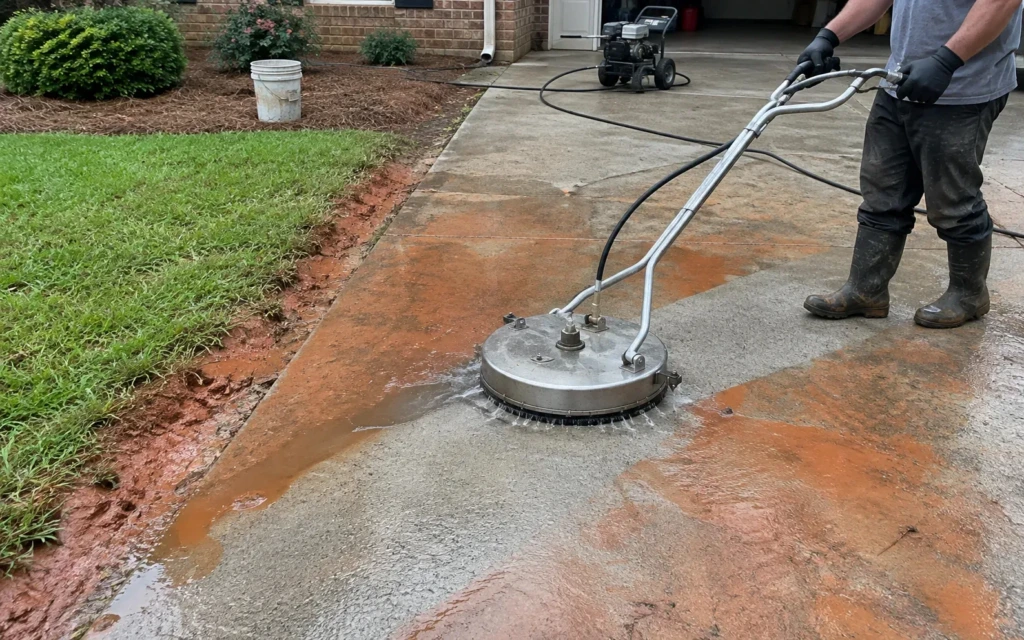
Sometimes. Fresh, surface-level clay often comes up with a good rinse. Old, set-in stains usually do not, because the pigment is inside the pores. Cranking the pressure up to chase it can etch the concrete and leave streaks. A professional surface cleaner (about 3,000 to 4,000 PSI at 4 to 8 GPM) gives even results on flatwork and avoids zebra stripes, but the stain removal itself is chemical.
How do you remove red clay from siding, brick and stucco?
Start with the gentlest method: low-pressure water, a soft brush and mild house-wash detergent. For orange film that stays, an iron remover made for the surface is the next step. Test first, rinse thoroughly, and keep acid off metal trim, painted surfaces and plants unless the label allows it.
- Vinyl: low pressure, spray downward, and never up under the laps where water can get behind the siding. A diluted oxalic-type rust remover is commonly used, but straight muriatic acid can haze vinyl. Neutralize and rinse well.
- Brick: pre-wet, use a masonry-safe iron remover, and rinse well. High pressure can erode soft mortar and drive pigment deeper.
- Stucco: very low pressure only. Stucco is porous and stains easily, so dwell and rinse carefully.
- Painted or stained wood: acid can lift finish, so test, or leave this to a professional.
- Fiber cement and composite trim: follow the manufacturer cleaning guidance, because a few products do not tolerate acids.
Siding questions homeowners ask
- Will vinegar ruin vinyl siding? A mild vinegar and water mix is commonly used on vinyl and does not usually damage it, but it is a weak cleaner for clay and can leave streaks. Rinse well and never mix it with bleach.
- What do professionals use on vinyl siding? Typically a low-pressure soft wash with a surfactant and sodium hypochlorite for algae and mildew, followed by a separate acid-based step for iron and clay stains. Because bleach and acid must never meet, the steps are rinsed and separated.
- Does Dawn remove mud from siding? It lifts loose mud, not baked-in iron pigment. Good for a pre-rinse.
- Why do the green streaks come off but the orange stays? Algae responds to bleach-based soft washing. The orange tint is iron, which needs the acid step.
The clay line at the base of a house is also a clue. If the stain climbs 12 inches or more, soil is splashing off bare ground, a gutter is overflowing, or a downspout is dumping beside the wall. Fix that, or the stain returns. Our house washing service is soft-wash based (under about 500 PSI) for exactly this reason.
What about pavers and brick walkways?
Pavers are especially clay-prone because joints hold soil and the surface is porous. Clean with a paver-safe iron remover, rinse, let the pavers dry, re-sand the joints with polymeric sand once dry, and seal after the sand cures. A sealer helps repel future splash, and most paver sealers are reapplied about every 2 to 4 years. See our paver cleaning and sealing page for the process, or deck and patio cleaning for patios and walkways.
Which surfaces need different handling?
- New concrete (under about 60 days): skip acid. Rinse often and control splash. Penetrating sealer specs commonly require 28 days of cure, so check the product.
- Stamped, stained or sealed concrete: the sealer may block the remover, or the acid may strip color. Test, or call a pro.
- Exposed aggregate: acid can etch the paste and loosen stones.
- Painted surfaces and metal: acids can dull paint and pit metal. Mask and rinse.
- Natural stone: limestone, marble and some sandstone react with acid. Use only products labeled for the stone.
How do you prevent red clay stains from coming back?
- Cover bare soil. Clemson Extension recommends a 2 to 3 inch layer of organic mulch in beds, which also reduces erosion. Use mulch or pine straw next to concrete, and sod or groundcover over bare red patches. Keep mulch pulled back from siding and slabs so rain does not wash it onto the surface.
- Fix grading. Soil should slope away from the house and not across the driveway. A swale, a small berm or a French drain can redirect muddy runoff in problem spots.
- Manage downspouts. Extend them several feet from the house or tie them into drain lines, and use splash blocks. Clogged gutters overflow down walls, so keep them clear (see our gutter cleaning cost guide and gutter cleaning service).
- Seal clean concrete. A penetrating silane or siloxane sealer reduces how much water and fine particle matter the concrete absorbs. Clean first, then seal. It helps, but it is not a force field, and splash will still need washing off.
- Rinse after construction or landscaping. Fresh red soil is the worst source. Rinse splash promptly before it dries into the pores.
- Wash on a schedule. Regular washing, covered in our guide on how often to pressure wash your house, catches staining while it is still light.
Greenville and Upstate context
The Upstate gets plenty of rain (the Cecil series range is 45 to 55 inches a year), so splash events are frequent, and new construction and landscaping regularly expose fresh red subsoil. The same iron-rich clay lies under yards from Greer, Simpsonville and Mauldin to in-town neighborhoods. Where a lot is cleared or regraded for a new driveway, patio or pool, your concrete takes the splash until lawn and mulch fill in. For a list of areas we serve, see our locations page.
Can you DIY it, or should you call a pro?
DIY makes sense for small, recent stains on plain, mature concrete. Call a pro when:
- The stain covers a large driveway, a whole elevation of siding or a large paver patio.
- The surface is brick, stucco, stained concrete or sealed pavers where the wrong acid can etch or discolor.
- You tried a remover and the color did not budge, or it left blotches.
- Plants, a pool, a well or a storm drain are near the work area and runoff must be controlled.
- You want cleaning and sealing done in the right order so the sealer does not trap leftover stain.
When you hire, ask which chemical they use on iron stains and how they protect plants and control runoff. Be wary of anyone who says they will just blast it off with high pressure or one product on every surface.
How much does it cost to remove red clay stains in Greenville?
Typical Greenville-area ranges are about $150 to $650 for a driveway (roughly 8 to 30 cents per square foot), about $250 to $1,000 or more for a house wash depending on size and stories, and paver cleaning and sealing at about 30 cents to $1.00 per square foot (sealing alone about 50 cents to $2.50). Heavy iron staining may add treatment time, and heated power washing usually runs 10 to 15 percent more. The final price comes from a quote, and our pressure washing cost guide breaks down the factors. A DIY remover, brush and protective gear costs less up front, but it takes your time, and mistakes on etched concrete are costly to reverse.
If red clay has taken over your driveway, siding or pavers, call (864) 477-1558 or request a free quote and we will tell you honestly whether a simple wash will do it or the stain needs a treatment first.
Why This Matters Here
The Upstate sits on Cecil series clay, a dense, iron-rich soil (the same iron oxide, hematite, that gives brick its color) that expands and shrinks with moisture. That movement is part of why older concrete poured without a properly compacted gravel base develops the hairline cracks where staining and algae take hold fastest, and it's a big part of why concrete here needs more frequent attention than it would on more stable, less clay-heavy soil elsewhere in the Southeast.
Sources
- soilseries.sc.egov.usda.gov: /OSD_Docs/C/CECIL.html
- en.wikipedia.org: /wiki/Ultisol
- uidaho.edu: /cals/soil-orders/ultisols
- a-c-s.confex.com: /a-c-s/2007am/techprogram/P32152.HTM
- radonseal.com: /why-red-clay-stains-are-hard-to-remove/
- radonseal.com: /how-to-remove-red-clay-stains-from-concrete-driveway/
- blueridgeexteriorcleaning.com: /blog/red-clay-stain-removal-house-exteriors/
- estatehub.io: /articles/red-clay-stains
It is one of the milder iron removers, but it is still toxic and corrosive. Wear goggles and gloves, keep it off plants, metal and glass, and rinse it off as soon as the stain lifts. Left on too long it can etch concrete. Always test a hidden spot and follow the product label.
New driveways sit next to freshly graded, bare subsoil, which is the biggest source of splash. New concrete is also more porous and sensitive to acids. Rinse stains often, add mulch or sod to bare soil, and wait until the slab has cured (check the label, often about 60 days) before using acid.
Yes, if the label says it is safe for that surface. Pre-wet the masonry, apply in small sections, keep it from drying, and rinse well. Avoid muriatic acid, which can damage mortar. After cleaning, let the surface dry, re-sand paver joints, and seal only once everything has cured.
It reduces them but does not eliminate them. A penetrating silane or siloxane sealer cuts how much water and fine particles soak into the pores, so stains stay nearer the surface and wash off more easily. Clean the slab first, because sealing over a stain locks it in. Plan on reapplying as the label directs.
Cover bare soil with mulch, pine straw, groundcover or sod, and keep beds slightly below the siding line. Extend downspouts away from the wall, clear gutters so they do not overflow, and make sure the ground slopes away from the foundation. Fixing the splash source matters more than cleaning.
Call when the stain is large, on brick, stucco, sealed pavers or decorative concrete, or when a home remover leaves blotches. A pro can match the chemical to the surface, control runoff, and clean and seal in the right order. For small recent stains on plain concrete, DIY is usually fine.
Get a Free Quote
Serving Greenville, SC and the Upstate. Call (864) 477-1558 or request a quote online. We reply quickly to every request.