How to Pressure Wash a Driveway Without Stripes or Damage
Quick answer: To pressure wash a driveway well, sweep it, pre-treat algae and oil, then clean it with a rotary surface cleaner on a gas machine rated around 3,000 PSI and at least 3 to 4 GPM, working in slow overlapping passes before a final rinse toward the lawn, not the storm drain. A bare wand with a 25 degree tip works for edges and small slabs, but on a full two-car driveway it is the main cause of zebra stripes. Plan on a morning for a typical driveway, let it dry 24 to 48 hours, and only then decide about sealing.
The rest of this guide covers what the rental counter will not tell you: how to size the machine, why flow matters more than pressure, how to handle the three stains specific to Greenville driveways (red clay, algae and oil), what to do about a sealed slab, where the wash water may go, and the honest math on renting, buying or hiring professional driveway cleaning.
Is it worth pressure washing your own driveway?
Often, yes. A driveway is flat, tough and forgiving compared to siding or a roof, so it is the one exterior surface where a careful first-timer can get a good result. What separates a clean driveway from a striped one is enough water flow and a surface cleaner, and most homeowner-grade machines are short on both.
Skip the DIY route if the slab is less than a year old (new concrete etches easily), if it is stamped or colored and sealed, or if the only place the water can go is the street. Those jobs are cheap to ruin and cheap to hire out; see our pressure washing cost guide for typical ranges.
What PSI and GPM do you need for a concrete driveway?
Pressure (PSI) breaks the bond between grime and concrete. Flow (GPM, gallons per minute) carries the loosened grime away. Most guides fixate on PSI, but on flatwork the flow number decides whether you finish in an hour with an even finish or spend the afternoon chasing stripes.
- Pressure: 2,500 to 3,000 PSI at the surface is the sweet spot. Pros own 3,000 to 4,000 PSI machines but size their surface cleaner nozzles to run closer to 2,500 to 2,750 PSI. Much above that you risk etching the cream layer off the slab.
- Flow: 2.5 GPM is the floor for wand work. 4 GPM or more is what a surface cleaner wants. Working pros say flatly that 2.5 to 3.2 GPM homeowner machines are undersized for a surface cleaner, because lifted dirt settles back before it is flushed away, which reads as striping.
- Electric machines: 1,400 to 2,000 PSI and under 2 GPM. Fine for a walkway, slow and stripe-prone on a full driveway.
If you are renting, this is why the 3,500 to 4,000 PSI gas unit is worth the extra $15 a day over the 2,000 to 2,700 PSI model. You are paying for the flow.
Which nozzle should you use on a driveway?
- Red, 0 degree: never on concrete and never near people. It etches a line into the slab and causes the injection injuries that send people to the emergency room. Consumer Reports recommends skipping it entirely.
- Yellow, 15 degree: stubborn spots only, held 12 inches or more off the surface, tested in a corner first.
- Green, 25 degree: the all-purpose tip for wand work, edges and joints.
- White, 40 degree: rinsing, and the safe choice near sealed concrete, pavers and siding.
- Turbo nozzle: a 0 degree jet spun in a cone. Fast on heavy buildup, leaves swirl marks if you pause.
Surface cleaner vs wand: why the surface cleaner wins
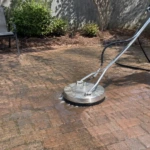
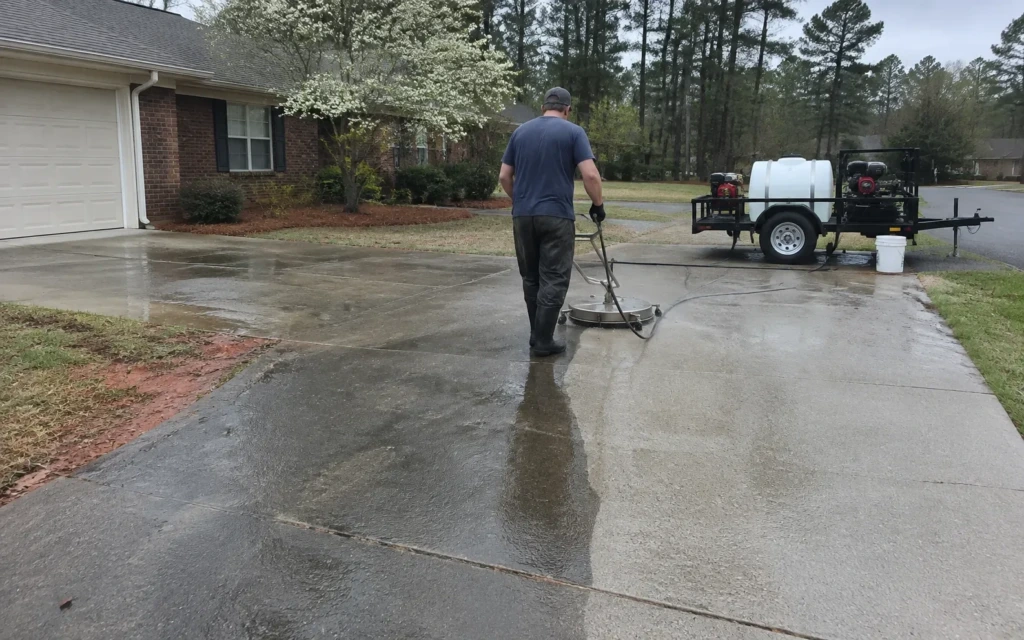
A surface cleaner is a hooded disk, usually 12 to 20 inches across, with a spinning bar that holds two nozzles at a fixed height above the concrete. Because the height and overlap never change, every square inch gets the same treatment. A wand puts a narrow fan on the concrete at whatever height, angle and speed your arm produces from one second to the next, and even skilled operators leave lines with it on open concrete. Keep the wand for what the hood cannot reach: the garage strip, expansion joints, curbs, steps and the edge beside the siding.
Sizing matters. Home Depot rents a compact surface cleaner for about $19 a day and a walk-behind model for about $37, and the counter will put either one on any machine. Match a compact 12 to 15 inch disk to a 3 to 4 GPM machine, and only run the big walk-behind hood on 4 GPM or more. A 2.5 GPM machine under a 20 inch hood delivers roughly 1,500 PSI at the concrete, which is why a well-meaning rental still comes out striped.
Pre-treating Greenville driveways: clay, algae and oil
Pressure removes dirt, not stains. Stains need chemistry and dwell time first, and Greenville driveways tend to carry three kinds that each need a different product.
Red clay film and orange halos
Upstate soils are weathered Piedmont clays colored by iron oxide, which is why the orange tint along driveway edges and under downspouts behaves like a rust stain, not dirt. Pressure lightens it but does not remove it, and bleach can make iron stains brighter. Use an oxalic or phosphoric acid based rust and clay remover, let it dwell a few minutes, scrub and rinse. Our post on why red clay stains Greenville concrete so fast explains the chemistry and the products that work.
Green and black algae
Shaded, north-facing and tree-covered driveways grow algae most of the year here. Pre-treat with diluted sodium hypochlorite (household bleach at roughly 1 part to 10 parts water, or a concrete cleaner made for it), keep it wet for about 10 minutes, then wash. Pros also post-treat with the same mix after washing, which is the standard fix for faint striping. Water the lawn and shrubs along the edge before you start and rinse them again when you finish.
Oil, grease and transmission fluid
Do not blast oil. High pressure on an untreated spot spreads it into a bigger, lighter smear. Apply an alkaline degreaser, give it 15 to 30 minutes, scrub with a stiff brush and rinse. Old, dark spots may need a poultice before any washing. The full stain-age playbook is in our guide to removing oil stains from a driveway.
Never mix products. Acid clay removers and bleach-based algae cleaners go on at different times with a full rinse in between.
Step by step: how to pressure wash a driveway
- Clear and sweep. Move cars, bikes, trash cans and planters. Blow or sweep off leaves, gravel and grit. Anything left behind clogs tips and gets flung at your ankles.
- Protect the surroundings. Close garage doors and windows. Soak the lawn and beds along the driveway. Cover anything you do not want sprayed.
- Pre-treat the stains. Degreaser on oil, acid remover on clay and rust, diluted bleach on algae. Give each its dwell time and do not let any of them dry on the concrete.
- Set up and test. Connect a 5/8 inch garden hose with full spigot flow (a kinked or thin hose starves the pump), purge air, start the engine and test the surface cleaner in a corner by the garage where mistakes hide.
- Wash with the surface cleaner. Start at the high end so dirty water runs away from clean work. Walk at a slow, steady pace and overlap each pass by a third to a half. The pattern working pros recommend: push the hood forward one arm length, slide over 6 inches, pull it back, slide over again. Never stop with the hood spinning in one spot.
- Detail the edges. Switch to the wand with a 25 degree tip for the garage strip, expansion joints, curb and apron. Keep the tip 12 inches off the concrete and keep it moving.
- Rinse. Use the 40 degree tip or the garden hose to push loosened grit and detergent off the slab and onto the lawn, starting from the top. Rinse the plants again.
- Post-treat if needed. If faint lines show as the slab dries, apply the diluted bleach mix across the whole driveway, let it dwell and rinse.
A two-car driveway, about 600 to 800 square feet, usually takes a first-timer 1 to 2 hours of washing, plus pre-treatment and the rental pickup and return. A crew with a 4 to 8 GPM rig needs about 30 to 60 minutes for the same slab.
How to avoid zebra stripes
Striping is the number one complaint in DIY driveway threads, and the causes are consistent.
- Wand instead of surface cleaner. The lines follow your arm. No technique fully fixes this on open concrete.
- Too little flow. Lifted dirt settles back between passes. This is the 2.5 GPM rental problem.
- Too much pressure at the tips. Stock nozzles on a 4,000 PSI machine cut lines. Pros size surface cleaner nozzles to run around 2,500 PSI.
- Uneven speed or overlap. Slowing down over a stubborn spot leaves a darker band. Go back for spots with chemistry, not a longer dwell under the hood.
- Worn or clogged nozzles. If one of the two tips is partly blocked, half the hood cleans and half does not.
- No pre-treat on algae. The leftover growth reads as a stripe. Pre and post treating with sodium hypochlorite is the pro fix.
Stripes from technique fade with a post-treatment and the next rain. Stripes etched by a 0 degree tip or by washing a slab that was too new are permanent.
Sealed vs unsealed concrete
Most broom-finished Greenville driveways are unsealed and can take the full process above. Stamped, colored and exposed-aggregate slabs are often sealed, and aggressive washing strips the sealer in patches, which looks worse than the dirt did.
Do the water drop test first. If drops bead and the concrete stays the same color, there is a sealer. If they soak in and darken within a few minutes, the slab is bare. On sealed concrete, drop to a 40 degree tip or lower pressure under the hood, lean on detergent and dwell time, and skip acid products unless the sealer maker says they are safe. Expect to recoat every 1 to 3 years, and never seal until the slab has dried 24 to 48 hours after washing, longer in humid weather, or the sealer traps moisture and turns cloudy. Pavers are a separate case because pressure blows out the joint sand; read our paver cleaning and sealing page before you put a surface cleaner on them.
Rent, buy or hire: the honest math
Here is what each path costs for a typical two-car driveway, using published rental rates and typical Greenville price ranges.
Renting
- Gas washer, 3,500 to 4,000 PSI: about $102 per day at Home Depot (a 2,000 to 2,700 PSI unit is about $87). Other chains run roughly $45 to $136 per day.
- Walk-behind surface cleaner: about $37 per day, or $19 for the compact disk.
- Detergent, degreaser and clay remover: roughly $30 to $60 depending on how many products you need.
- Fuel, a refundable deposit, taxes, and two trips to the store.
- Realistic total: about $170 to $220 and most of a Saturday. Split one rental day with a neighbor and the per-driveway cost drops by nearly half.
Buying
A decent electric washer runs about $150 and a gas unit about $350, but those are 2.5 to 3.2 GPM machines, which brings you back to the striping problem. A machine with the flow to run a surface cleaner well costs considerably more, and then you are storing, winterizing and maintaining a gas engine. Buying makes sense if you will use it more than two or three times a year on a deck, fence and patio too. Otherwise renting is cheaper for a decade.
Hiring
Professional driveway cleaning in the Greenville area typically runs about $150 to $650, roughly $0.08 to $0.30 per square foot. For a two-car driveway that is often within $50 to $150 of the rental total, and the difference buys a 4 to 8 GPM machine, commercial chemistry for clay and algae, no stripes, no Saturday and no wash water problem. Bundling the driveway with a house wash or a deck and patio cleaning usually lowers the price of each.
Safety: what sends people to the ER
The Consumer Product Safety Commission counted about 6,000 emergency room visits from pressure washers in a single year, and 14 percent led to a hospital stay.
- Injection injuries. The stream can push water and bacteria under the skin through a wound that looks like a scratch. The CDC says the severity is generally underestimated. Any skin break from the spray needs a doctor the same day.
- Nozzle discipline. Skip the red 0 degree tip, start with the widest angle that works, and never point the wand at anyone, including your own feet.
- Gear. Safety glasses, closed-toe shoes with grip (wet concrete plus algae is a skating rink), long pants and gloves. The hand is the most common injection site.
- Gas engines. Outdoors only, never in the garage with the door cracked. Carbon monoxide builds fast.
- Chemicals. Bleach and acid cleaners each need eye protection and gloves. Keep kids and pets inside until the slab is rinsed.
Where can the wash water go in Greenville County?
Everything you rinse off the driveway flows to the lowest point, and if that is a curb inlet it goes straight to a creek, because storm drains are not treated. Greenville County runs an illicit discharge detection and elimination program under its stormwater permit, and its guidance to mobile cleaning businesses states that wash water from cleaning driveways, sidewalks, patios and parking lots with detergents is treated as an illicit discharge when it reaches the storm system. The County takes reports from unincorporated areas, and the cities of Greenville and Greer run their own stormwater programs.
The practical rules for a homeowner:
- Absorb and degrease oil before you wash, so it is not in the runoff at all.
- Direct rinse water onto your own lawn or a mulched bed, where the soil filters it. Plain hose water is not the concern; soap, bleach and oil are.
- Block the curb inlet with a sandbag or rolled towel if the driveway drains toward the street, and sweep up the silt behind it.
- If the only drainage path is the street and you plan to use detergent, hire a crew with containment and recovery equipment.
Best time of year to wash a driveway in the Upstate
Late March through April is when pine and oak pollen coats every flat surface in Greenville yellow, so washing in mid March means washing again in May. Late spring after the pollen drops, or early fall after the summer algae season, gives you the longest clean stretch. Avoid the hottest afternoons, when detergent and bleach dry on the concrete before they can work. Our guide on how often to pressure wash your house covers timing for the rest of the exterior.
Shade matters more than the calendar. Driveways under heavy tree cover, like the wooded lots on the slopes around Paris Mountain or the established streets in Greer, stay damp longer and grow algae faster than a driveway in full sun in a newer Five Forks subdivision. Expect to clean a shaded slab every year and a sunny one every two or three.
When to call a pro instead
- The concrete is under a year old, or it is stamped, colored or exposed aggregate.
- You already have stripes from a previous attempt and want them blended out.
- Oil stains are old and dark, or there is heavy rust from well water or fertilizer.
- The driveway is long, steep or drains only to the street.
- You want the house or roof done at the same time. Roofs and most siding need a soft wash, not pressure, so a driveway rental does not help there anyway.
Before you hire anyone, ask three questions: Do you use a surface cleaner on driveways? What is your machine’s GPM? What do you do with the wash water? Yes, 4 GPM or more, and a clear runoff plan are the answers you want.
If you would rather hand the job to a crew that does this every day, we clean driveways across Greenville and the Upstate with surface cleaners, clay and algae pre-treatment and runoff control. Call (864) 477-1558 or request a free quote and we will price it from your driveway, not a national average.
Sources
- bobvila.com: /exterior/how-to-pressure-wash-a-driveway/
- farmandfleet.com: /blog/pressure-wash-driveway/
- toptenreviews.com: /how-to-pressure-wash-a-driveway
- pressurewashingresource.com: /community/t/still-getting-stripes/19260
- pressurewashingresource.com: /community/t/driveway-stripes-and-nozzle-tips-surface-cleaner/14802
- pressurewashingresource.com: /community/t/surface-cleaner-advice/31069
- bobvila.com: /diy/how-much-to-rent-a-pressure-washer/
- slashgear.com: /1571949/home-depot-pressure-washer-rental-how-long-what-cost/
Yes for a small walkway or a sealed patio, but a full driveway will be slow and streaky. Electric units run about 1,400 to 2,000 PSI and under 2 GPM, which is not enough flow to carry dirt away evenly. If an electric washer is all you have, pre-treat with cleaner, use the 25 degree tip with steady overlapping passes, and plan to post-treat algae to even out lines.
You can park on bare concrete as soon as it is rinsed, though waiting a few hours keeps tires from tracking grit back onto the slab. If you applied a sealer, keep cars off for the full cure time on the label, often 24 to 72 hours, and longer in humid Upstate weather. Driving on uncured sealer leaves tire marks that are hard to remove.
Usually not. Most crews need an outdoor spigot, the driveway clear of vehicles, and a way to reach any gate. Move cars to the street the night before, close garage doors and windows, and mention any oil spots, rust, cracks, or a sealer so the crew brings the right products. Ask for photos or a text when the job is finished if you are away.
Most quotes start with the approximate size of the driveway, the condition (oil, rust, clay, algae), the type of surface (broom-finished, stamped, pavers), and your address so the estimator can check satellite imagery or stop by. A few photos from your phone speed it up. Driveway cleaning in the Greenville area typically runs about $150 to $650 depending on size and stains, with the final price confirmed on a quote.
Usually. Tire marks are rubber and road grime and come off with a degreaser and the surface cleaner. Leaf and acorn tannin stains, the brown shadows left after fall, lift with a diluted sodium hypochlorite pre-treat and dwell time. Deep, old tire marks on smooth or older concrete may need a second pass or a hot-water machine, and some faint shadowing can remain until sun and rain finish fading it.
Only when it is done wrong. A 0 degree tip, holding the wand too close, running a surface cleaner at full 4,000 PSI, or washing concrete less than about a year old can etch the surface and expose the aggregate. Pressure washing does not cause structural cracks, but it can blow out loose material from cracks that were already failing, so note those spots and keep the hood moving over them.
Get a Free Quote
Serving Greenville, SC and the Upstate. Call (864) 477-1558 or request a quote online. We reply quickly to every request.